

AI Good and Bad
- Thread starter bigredfish
- Start date
You are using an out of date browser. It may not display this or other websites correctly.
You should upgrade or use an alternative browser.
You should upgrade or use an alternative browser.


Game over. Chinese AI companies are crushing prices and putting massive pressure on the American AI bubble.
The era of expensive GPUs, expensive data centers, and unlimited AI spending is coming to an end.
AI will keep growing. That doesn’t mean every AI stock will.
I expect many AI stocks to fall as much as 90% when this cycle turns.
$NVDA $AMD $SMCI $AVGO $ARM $TSM $MU $INTC $PLTR $ORCL $CRWV $META $MSFT$ GOOGL $AMZN
The era of expensive GPUs, expensive data centers, and unlimited AI spending is coming to an end.
AI will keep growing. That doesn’t mean every AI stock will.
I expect many AI stocks to fall as much as 90% when this cycle turns.
$NVDA $AMD $SMCI $AVGO $ARM $TSM $MU $INTC $PLTR $ORCL $CRWV $META $MSFT$ GOOGL $AMZN


I was waiting for that....Game over. Chinese AI companies are crushing prices and putting massive pressure on the American AI bubble.
The era of expensive GPUs, expensive data centers, and unlimited AI spending is coming to an end.
AI will keep growing. That doesn’t mean every AI stock will.
I expect many AI stocks to fall as much as 90% when this cycle turns.
$NVDA $AMD $SMCI $AVGO $ARM $TSM $MU $INTC $PLTR $ORCL $CRWV $META $MSFT$ GOOGL $AMZN
Great post-- There IS a ceiling, and China will find it and undercut everyone else by 20%, and a massive amount of your data will be manipulated by them, not that it matters much at this point. Feels like we're building towards something, but Is it the Matrix or Terminator?
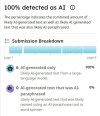
Meanwhile in my class.... <imagine the graphic of another 100% AI-generated paper discovered via AI-Detection that IPC forum error won't let me upload>

Arjun
IPCT Contributor

mat200
IPCT Contributor
- Jan 17, 2017
- 18,991
- 31,771
The Riskiest Moment of the AI Bubble
Hank Green
3.14M subscribers
Jun 9, 2026
NOTE! Since I recorded this video:
1. OpenAI has indeed made it’s first filing to go public, though how long from now that will happen is unclear.
2. SpaceX’s IPO numbers are in with 2X oversubscription, which is impressive in absolute numbers, but is also easy to over-read. That’s modest over-subscription for an IPO. But, as with anything Musk-shaped, it could go a lot of different ways!!
In this video, Hank Green discusses what he terms the 'riskiest moment' of the current AI bubble (4:19), characterized by a massive demand for new capital to fund AI development.
Hank Green
3.14M subscribers
Jun 9, 2026
NOTE! Since I recorded this video:
1. OpenAI has indeed made it’s first filing to go public, though how long from now that will happen is unclear.
2. SpaceX’s IPO numbers are in with 2X oversubscription, which is impressive in absolute numbers, but is also easy to over-read. That’s modest over-subscription for an IPO. But, as with anything Musk-shaped, it could go a lot of different ways!!
In this video, Hank Green discusses what he terms the 'riskiest moment' of the current AI bubble (4:19), characterized by a massive demand for new capital to fund AI development.
Key Takeaways:
- Massive New Capital Requirement: Major companies like Google ($85 billion), SpaceX ($75 billion), and firms like Anthropic and OpenAI are seeking to raise hundreds of billions of dollars in new capital (0:00, 1:41, 5:17). Unlike typical stock trading where existing shares change hands, these offerings represent a need for new money to enter the market (2:01, 3:55).
- The AI Bubble: While the underlying technology may be transformative—similar to railroads or the internet—the author argues that investors are currently paying 'too much too soon' (8:46). The risk lies in whether there is enough actual liquidity to satisfy these massive demands (6:06).
- Google's Strategy: Hank suggests that Google's push to raise capital now is a savvy move to secure safety and capital while the bubble is still inflated, potentially absorbing demand that would have gone to competitors (7:28).
- The 'Real' Test: This period marks a shift from a market driven by 'belief' to one that requires 'real cash' (4:27). The author warns that if investor confidence shifts to caution, the sheer cost of maintaining these high valuations could cause the bubble to face significant challenges (9:30).
Conclusion:
Hank concludes by expressing his personal preference for a low-risk, long-term investment strategy—which he likens to a Honda Civic—rather than betting on the volatile fluctuations of the current AI hype cycle (12:02).Google's Strategy: Hank suggests that Google's push to raise capital now is a savvy move to secure safety and capital while the bubble is still inflated, potentially absorbing demand that would have gone to competitors (7:28).
It's like a Black Friday door buster sale offering cheap money with the major AI companies as customers...



mat200
IPCT Contributor
- Jan 17, 2017
- 18,991
- 31,771
It's like a Black Friday door buster sale offering cheap money with the major AI companies as customers...
View attachment 244745
nice visual