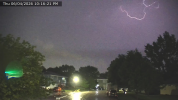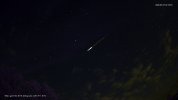
Not sure where exactly to post this thread so I'll dump it here in chit-chat. I've been toying with the idea of catching meteorites on camera. In late March, we had a daytime meteorite that produced a sonic boom in Ohio, and a few nights ago there was another high profile visible fireball in the sky that produced no noise.
My question for the brain trust here is: Do I need to homebrew some kind of camera like a Sony IMX 585 sensor and find a wide angle lens and a camera dome that will work for me or is there something available commercially out there that I can open a box, mount pointed to the sky and not have to think about again? After some research it appears that a lot of the Starvis/2/3 sensors end up in dashcams but I get the feeling that if I were to pluck a sensor directly out of one (probably build on a custom backplane w/o PoE availability) it won't do me much good at all. I also don't want USB2/3 as my transmission means. PoE or bust.
I don't care about feeding to meteor networks, and I don't care about anything other than the recordings I get off the camera. I feel like its irrelevant but I'll be dumping this video into an Avigilon Unity 8 system. I understand the market for such a camera is VERRRRRYYYYYY small so if I need to build something then so be it, I'm not afraid to do so but I also like opening boxes and going the "happy and stupid" route sometimes too.
My question for the brain trust here is: Do I need to homebrew some kind of camera like a Sony IMX 585 sensor and find a wide angle lens and a camera dome that will work for me or is there something available commercially out there that I can open a box, mount pointed to the sky and not have to think about again? After some research it appears that a lot of the Starvis/2/3 sensors end up in dashcams but I get the feeling that if I were to pluck a sensor directly out of one (probably build on a custom backplane w/o PoE availability) it won't do me much good at all. I also don't want USB2/3 as my transmission means. PoE or bust.
I don't care about feeding to meteor networks, and I don't care about anything other than the recordings I get off the camera. I feel like its irrelevant but I'll be dumping this video into an Avigilon Unity 8 system. I understand the market for such a camera is VERRRRRYYYYYY small so if I need to build something then so be it, I'm not afraid to do so but I also like opening boxes and going the "happy and stupid" route sometimes too.